
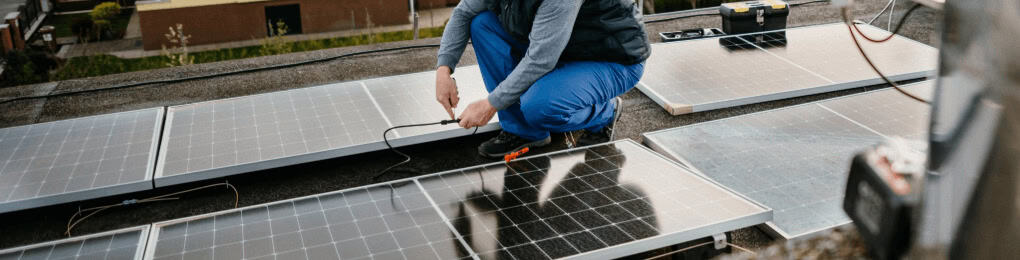
Many midwestern homeowners ask, “How do solar panels work?” but they should really be asking “Are solar panels worth it?” Solar sounds great on paper, but in the Midwest, the technology is proving to be more difficult to implement and not nearly as beneficial as originally thought. As a result, many homeowners are now asking:
- How do solar panels work?
- Why did solar never take root in the Midwest?
- What about solar panel maintenance?
- What are the pros and cons of solar in the Midwest?
- Are solar panels worth it for Midwest homeowners?
- What needs to change for the Midwest to adopt solar power?
In this article, we’ll use our experience as master electricians to help answer all these questions, so Midwestern homeowners can decide if solar power is the right fit for them.
How Do Solar Panels Work?
If you don’t understand how solar panels work, you won’t be able to tell if they will work for you. Solar panels use photovoltaic cells, which turn sunlight into direct current electricity. That power flows through the inverter, which converts it into the kind of power your home can use. From there, the electricity either powers your home or flows back to the grid. And if your system produces more power than you use, that extra power may be credited to you through net metering, depending on your utility company.
Some solar panels also include batteries, but many Midwest systems do not, since batteries add major cost. Solar panels do not store power on their own. Without batteries, they only work when the sun is out. And in the Midwest, that is not always a guarantee, especially during the colder months when homes arguably need electricity the most.
Weather is not the only factor that impacts solar panel power production, though. Solar panels tend to work best when installed on roofs facing south and not covered by shade from trees or buildings. The size of your usable roof space also matters, since more space means more panels and more energy production. However, larger homes do tend to use more electricity, which affects how much of your bill solar panels can offset. While each home’s energy bill is different and will be affected by solar panels to varying degrees, a 7kW solar panel system can save homeowners an average of $125.99 a month, according to the Kansas Solar Panel Cost report. For many homeowners this will not eliminate their electric bill, but it can lessen it.
Why Did Solar Never Take Root in the Midwest?
Solar did not spread evenly throughout the country; it exploded on the coasts. This mainly happened on the coasts due to the following reasons:
- Electricity costs are much higher on the coasts
- State incentives covered large parts of installation costs
- Dense cities pushed energy reform faster
- Net metering programs paid homeowners well for extra power
In states like California and New York, solar often paid for itself faster because utility bills were already high. But in the Midwest, electricity is cheaper, power grids are more stable, and wind power already does a lot of the renewable heavy lifting. Not to mention, most Midwest states offer little to no local solar incentives, meaning installation costs stay high. As a result, solar can take 10-15 years to break even, whereas coastal areas have an average payback period of 5-10 years, assuming nothing goes wrong.
What About Solar Panel Maintenance?
Sales pitches rarely cover solar panel maintenance, but electricians see it all the time. Here’s what solar panel maintenance really looks like:
Regular Cleaning
Solar panels are constantly exposed to the elements, meaning they need regular cleaning to work properly. This means investing in a telescopic pole that you can use to clean your roof-mounted solar panels from the ground. You will also need a soft-bristled brush, garden house, lukewarm water and soap solution, and a squeegee to remove any excess water after cleaning and rinsing.
If snow accumulates on your solar panels during the winter, you can either wait for it to slide off your panels, or use a solar panel rake to remove the powdery substance. Do not climb on your roof during the winter when ice may be present. If you have stubborn snow or dirt that won’t come off your solar panels, contact a professional to handle the roof cleaning.
Replace Panels and Inverters
While the solar panels themselves can last up to 30 years with proper care, the same cannot be said for their inverters. These critical components convert the direct current electricity produced by solar panels into alternating current electricity your home can actually use. The more they are used and exposed to the elements; the sooner solar panel inverters will need to be replaced. Generally speaking, these inverters last up to 10 years when they are maintained well.
Find a Local, Experienced Service
A regular maintenance plan is absolutely necessary to keep solar panels working optimally and your home running smoothly. But the number of electricians who actually know how to care for and repair solar panels is low, especially in the Midwest where the service isn’t as widely needed. As a result, speedy and expert service is not always a guarantee, putting your solar panels and home at risk.
What are the Pros and Cons of Solar in the Midwest?
Remember, the answer to “Are solar panels worth it?” is situational. Every home, environment, and electrical service is different, so while some people may benefit from solar panels, others may not. When making the decision, it’s important to weigh the pros and cons of solar clearly. Some major benefits include:
- Access to renewable energy
- Lower electric bills (in some cases)
- Works during daylight hours
- Adds value in certain markets
However, for every pro there is a con to solar power in the Midwest:
- High upfront cost
- Long payback timeline
- Limited installation assistance incentives
- Maintenance and repair needs
- Weather impact
- Grid limitations
Solar power is not a scam; it’s just not a perfect fit for the Midwest yet. There’s no denying that solar power is better for the environment, but it is so difficult to implement that many homeowners simply can’t use it.
Are Solar Panels Worth It for Midwest Homeowners?
“Are solar panels worth it?” This question continues to plague Midwest homeowners, and the honest answer is that it depends, but generally speaking, no. This is because solar requires high upfront costs, long contracts, roof modifications, utility approval, long payback timelines, and more. So, if you plan on moving in ten years, solar usually doesn’t pay off. When incentives are limited like they are in the Midwest, solar struggles to compete with cheap grid power. Not to mention solar power maintenance and emergency repairs can cost hundreds or even thousands of dollars depending on the damage. This doesn’t mean that solar is bad though, just situational.
What Needs to Change for the Midwest to Adopt Solar Power?
Solar power could grow in the Midwest, but several things would need to change, such as:
- Better state incentives: Requires homeowner friendly rebates or low interest financing at the state or utility level.
- Lower battery costs: States cannot lower global battery prices, but they can remove local costs that make batteries more expensive.
- Faster payback periods: Installation costs need to be lowered, and billing credits need to be fair and predictable for faster payback to be possible.
- More trained service electricians: Registered apprenticeships and training partnerships need to expand and recognized credentials encouraged.
- Utility rate increases: When utility rates go up, solar savings can increase because each kWh you offset is worth more.
Until this happens, though, adoption of solar power will have to start slowly. For now, Midwest homeowners can invest in energy efficient lighting, smart load planning, and EV charging stations to be more sustainable. These upgrades deliver immediate value without long contracts or risks that come with solar panels.
“Are Solar Panels Worth It?” and Other FAQs
Yes, but snow reduces output until panels clear.
They still produce power, but less.
Usually not in the Midwest.
Panels last 25 to 30 years. Inverters often last less.
It can be, especially for repairs.
Sometimes, but not always.
Rarely without batteries.
Most systems shut off without batteries.
It depends on wiring and panel capacity.
For many Midwest homeowners, yes.
Ready to Make Your Home Energy Efficient?
Landis Electric Can Help!
There are plenty of pros and cons of solar power that need to be considered before you make a decision, but generally speaking this system isn’t a good investment for Midwest homeowners. This doesn’t mean you have to give up on having an energy-efficient home though. Electrical panel upgrades, EV charger installation, lighting updates, and more can reliably help improve your home’s sustainability. Call to schedule a consultation today to have one of our master electricians help find an energy-efficient solution that works for you.
Enjoy content from Landis Electric KC? Make us one of your preferred sources on Google.